
Monkeypod
The great tree of the Caribbean savannas. A wood with rich, deep heartwood and a pale live edge, low shrinkage and a figure that makes every slab one of a kind.
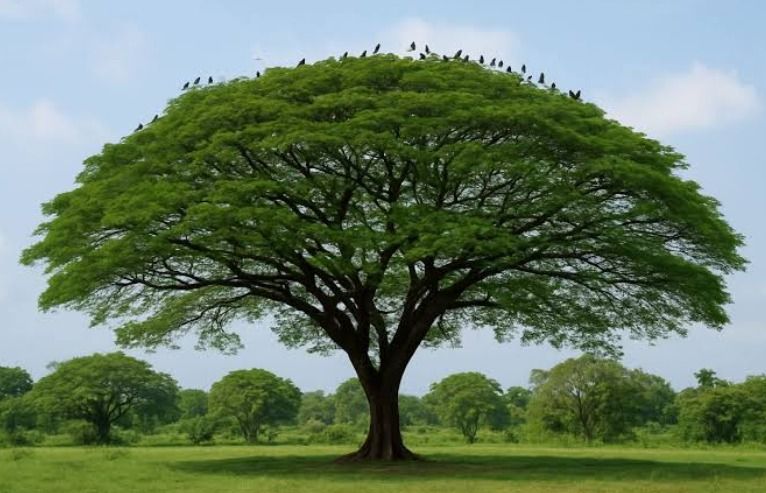
Samanea saman, one tree with many names around the world
Original Samanea saman from Colombia
- Native to Colombia, where it is called campano: it grows naturally in our savannas and pastures.
- Rich, deep-colored heartwood with beautiful golden edges along the live edge.
- Mature trees with a long growth cycle: a large trunk diameter, fully developed heartwood, wide slabs and an exceptional grain pattern.
- Slabs from our own production in Los Palmitos, Sucre, Colombia.
Suar from Asian plantations
- Not native to Asia: all suar from Asia was planted there in plantations and does not grow there naturally; the tree originates in tropical America.
- Traded as “Albizia saman” (a synonym in botanical nomenclature). The original Samanea saman and Asian suar belong to the same family, Fabaceae. The difference lies in the growth cycle: our native trees in Colombia complete a full growth cycle, unlike the plantation trees in Asia, resulting in a deeper, high-end color pattern and a higher quality of wood.
- In our experience, suar is a duller grey with a less deep color pattern.
Same botanical family. The difference is the full growth cycle of our native, mature trees in Colombia compared with plantation trees in Asia: that is why our monkeypod has a deeper, high-end color pattern and a higher quality of wood than plantation suar.
The numbers
Average reference values for the species.
More stable than teak, as hard as mahogany
Same source, same method: The Wood Database. Lower shrinkage means less movement once the piece is in your home.
Volumetric shrinkage
Janka hardness
What the woodworker needs to know
- Color
- Heartwood golden to dark brown, sometimes with darker streaks. Thin yellow or white sapwood, clearly demarcated — the contrast that makes our live-edge slabs unique.
- Figure
- Curly figure and wild grain are common.
- Grain & texture
- Grain usually straight, sometimes interlocked or wavy. Medium to coarse texture, medium to large pores, moderate natural luster.
- Durability
- Durable to very durable against decay; resistant to most insects.
- Workability
- Easy to work with hand and machine tools. Interlocked grain may tear out when planing.
- Gluing & finishing
- Glues and finishes well: oils, lacquers and epoxy resin.
- Odor
- No characteristic odor.
- Sustainability
- Species native to Colombia; no forest or jungle is cut down. Not listed in the CITES Appendices and rated Least Concern (LC) by the IUCN.
- Uses
- Live-edge and river tables, table tops, furniture, cabinetry, carving and turning, veneer, musical instruments (guitars and ukuleles).
Sources
- The Wood Database — Monkeypod, Teak, Honduran Mahogany, Black Walnut.
- Royal Botanic Gardens, Kew — Plants of the World Online: Samanea saman.
- Wikipedia — Samanea saman (common names, introduced range, IUCN Least Concern).
- USDA Forest Service — Trees of Puerto Rico: Samanea saman (Spanish edition).
Reference values are species averages from the literature and vary from piece to piece; they are not laboratory tests of a specific lot.
Contact
Ask for a price or send us your sizes
Leave your details and your question. We reply the same working day, by email or WhatsApp.
WhatsApp +57 322 655 9279
E-mail ventas@fogatamadera.com